Verification Optimization
Verification Optimization is a crucial module within Treatment Optimization that enhances the reliability and robustness of the predicted movement patterns generated by Tracking Optimization. It serves as a validation step to ensure that the control strategies obtained from Tracking Optimization can reproduce the experimental data accurately and reliably, even when the tracking of specific quantities is eliminated. By assessing the performance of the calibrated controllers in the absence of explicit tracking, Verification Optimization provides a comprehensive evaluation of the predictive capabilities of Treatment Optimization.
Inputs
- OpenSim model file (.osim)
- NMSM Pipeline model file (.osimx) (Optional)
- Tracking Optimization results directory.
- This directory should be both the tracked quantities and initial guess directory for most applications.
- GPOPS II settings file (.xml)
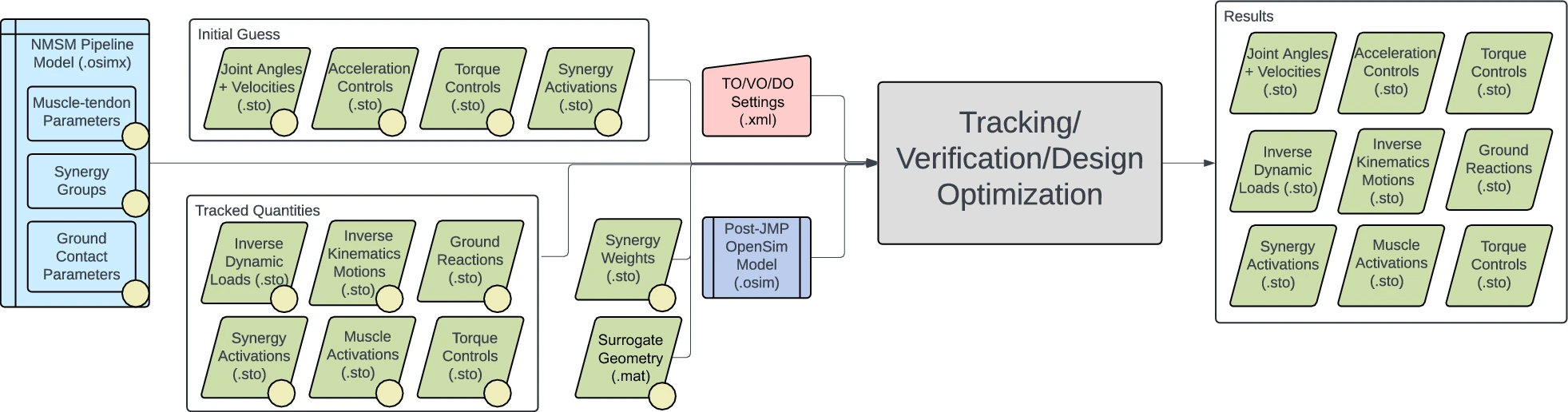
Outputs
- IKData: Joint angles
- IDData: Joint loads
- GRFData: Ground reactions
- accelerations.sto: State accelerations
- combinedActivations.sto: Muscle activations produced by synergy controls
- replacedExperimentalGroundReaction.sto: Modeled ground reactions with moments reported about the midfoot superior marker projected onto the ground
- states.sto: State coordinate positions and velocities
- torqueControls.sto: Torque control signals
- synergyCommands.sto: Time-varying synergy commands
- synergyWeights.sto: Time-invariant synergy weights
Importance
Verification Optimization serves as a “sanity check” for your TO results before moving further into the Treatment Optimization Process. It is possible that your TO run could have converged to a good-looking solution but had problems that will make a Design Optimization (DO) difficult. VO allows you to test that the input data that you give to DO is consistent with itself. Additionally, VO may serve as a “dry run” for your DO run. In other words, your VO run will be identical to your DO run, but without any of the design elements of the DO run.
If a VO run does not converge quickly, there is either an issue with your TO results, or with your VO problem formulation. In either case, it is important to catch these issues before introducing additional problem complexity in Design Optimization.