Joint Model Personalization
Explanation
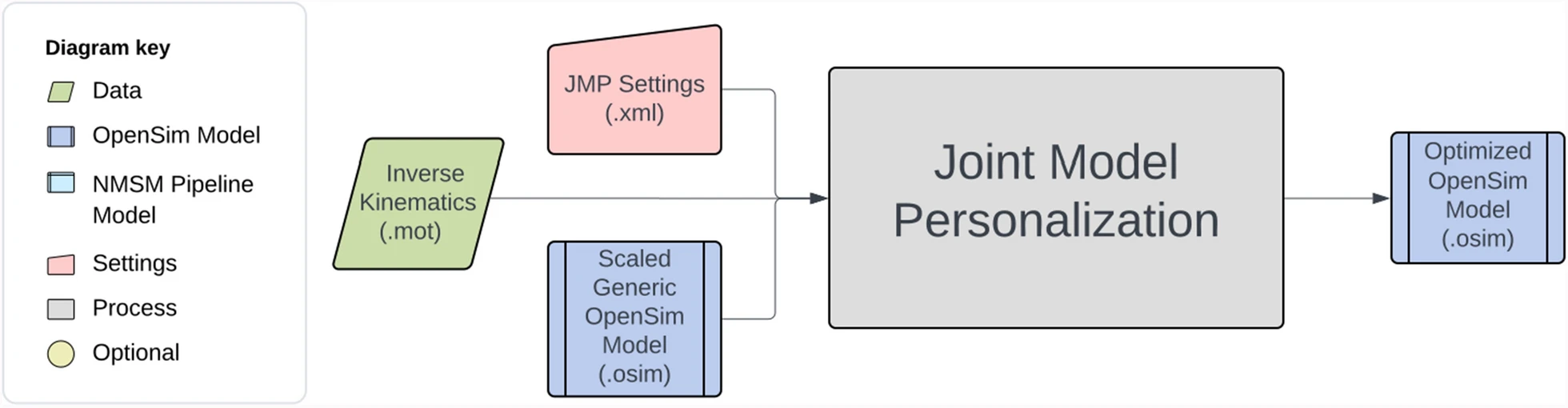
Joint Model Personalization is the first tool in the NMSM Pipeline and focuses on using optimization to personalize the joints of a scaled OpenSim model. A scaled generic OpenSim model does not typically describe the unique joint geometries of most people, especially clinical populations. As a result, inverse kinematics, inverse dynamics, and other downstream computations will diverge from accurately describing the person being modeled. Thus, JMP edits joint geometries in the OpenSim model in order to more accurately describe the specific subject.
Inputs
- Scaled OpenSim model (.osim)
- Marker data file (.trc)
Outputs
- Modified OpenSim model with new joint geometries (.osim)
Background
Based on a paper by Reinbolt, et al., JMP optimizes select joint parameters, marker positions, and body segment scales in order to find a set of values that minimizes calculated inverse kinematics marker position errors across the data (motions) provided.
Joint parameters are not usually considered when using OpenSim; most default joint parameters are selected using cadaveric data and modelers tend to not modify these values. Even so, using default model values fails to produce consistent results. Modifying joint parameters intelligently can dramatically improve the usefulness of the model and the accuracy of downstream computations.
Importance
JMP is the first tool because it determines the accuracy of all following computations. Reinbolt, et al., as a follow up study, showed that joint torques from inverse dynamics are significantly more accurate after calibrating joint parameters.